Hamburgers in a Beer Cooler
This is a guest post written by Hugh Morgan. Thank you, Hugh!
A few weeks ago, I was reading through The Food Lab by Kenji Lopez-Alt when I came across a section on cooking with a beer cooler. I wasn't paying much attention, and frankly, the topic seemed pretty fantastical---I was sure I didn't really understand it properly (what does he mean by a "beer cooler"?) So I just flipped forward to the next section. But then later in the cookbook, he mentioned it again. Then it hit me......when he said he liked to cook meat in a beer cooler, what he meant was that HE LIKED TO COOK MEAT IN A BEER COOLER. I couldn't quite get my head around it until he explained that this is basically a DIY way of cooking sous vide using only hot water and a standard cooler.
At the risk of eating some seriously undercooked proteins, I spent a week experimenting with this method of cooking. I tried pork tenderloin, hanger steak, even chicken (!) The results were.....really delicious. The meat was all cooked incredibly evenly and the texture was perfect. Even boneless, skinless chicken breast (which I consider the most boring of proteins) was really flavorful.
Last night, I took the plunge of using this method for hamburgers. That's right. I took a 1/2 lb of ground chuck, formed a full size patty, applied salt and pepper, sealed it in a ziplock bag (trying to get rid of as much air as possible), and submerged it in a cooler with 135 degree water for about 1 hour (Kenji recommends a minimum of 30 minutes and up to 3 hours). Then I removed the burger, dried it with paper towels, applied some more salt and then fried it for one minute per side on high heat in a cast iron skillet with a bit of vegetable oil.
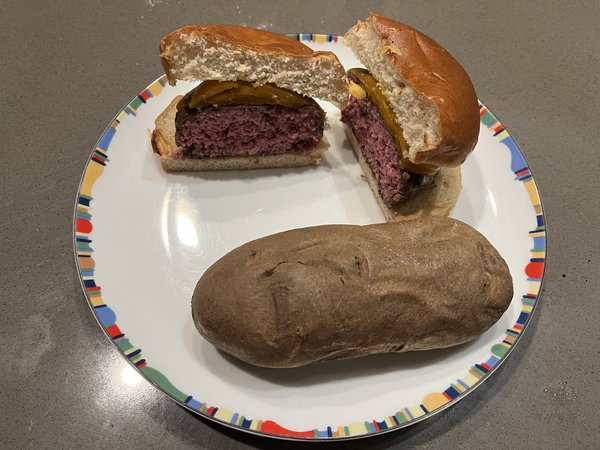
The result? That was one delicious hamburger. I mean really, really delicious. I may never cook a burger any other way again. I made another burger for my son (who likes his burgers medium-well or well) in 155 degree water and it too came out fantastic; although it had a bit of red to it, the texture was much firmer and more fully cooked (see nearby picture). Needless to say, he inhaled it.
The one flaw worth mentioning is the crust. Kenji loves a good crust on his burger, but the 1-minute-sear-on-each-side didn't really produce much of a crust. The problem could be that my burgers were slightly larger than Kenji's (8 ounces vs. 5-6 ounces). Or possibly I need to let the skillet heat up longer (but the oil was smoking so this seems unlikely). One other option that is discussed in The Food Lab is to deep fry (!!) the burger in a dutch oven. I might try a version of this next time---not deep frying it, but cooking it in a heavier amount of oil in an attempt to get a bit more bark on my burger.
Other things to consider if you embrace the world of the beer cooler...it took me a few iterations to figure out the correct water temperature. I found all the recommended temperatures a bit low, so I generally cooked the meat 5-10 degrees higher than instructed. I have yet to make anything that felt overcooked. Also make sure you recalibrate the water temperature every 20-30 minutes. You might want to start with a protein that you prefer to eat on the rare side (e.g., red meat) before moving on to something like chicken or fish. And frankly, if you are nervous about eating undercooked food, this method may not be for you.
But for the rest of us, I would encourage you to embrace the world of the beer cooler! You won't regret it.