turkey breast en cocotte
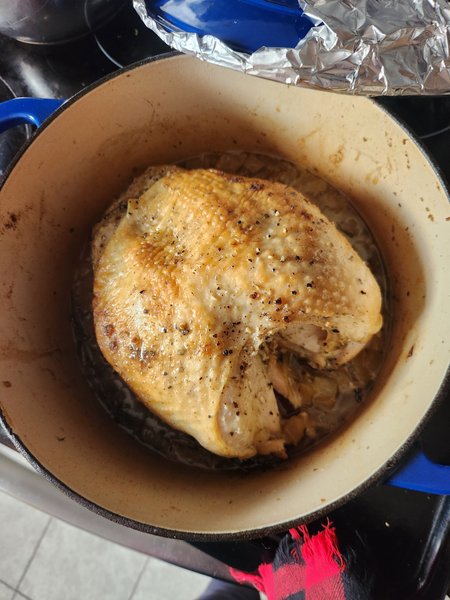
America's test kitchen
I love turkey breasts and I'm not afraid to admit it. I routinely stock my fridge with cooked turkey breasts, and add slices of it to whatever salad or dinner that I'm having. I love the taste and I love how much meat a turkey breast yields. It's a great bang-for-your-buck cut.
Up until trying this recipe, I had been loyal to Samin Nosrat's method for turkey breasts. She has you de-bone the breasts, sear their skin on a hot skillet, then finish them in a hot oven. This approach works great if you dry-brine the (de-boned) breasts, and even better if you wet-brine them. I was (and am) perfectly happy with this approach, but decided to try a new one when reading Catherine Shanahan's book, Deep Nutrition. According to Shanahan, meat gets more flavor and nutrients from being cooked slowly on the bone. And so, hoping to put this philosophy to the test, I tried out the turkey en cocotte recipe, which has you cook the entire breast, bones and all, slowly in a dutch oven. The only similarity this recipe has with Samin's is that both have you sear the skin.
In some ways, the en-cocotte recipe was better than Samin's, and in others, it was worse. I will agree with Shanahan's sentiment that cooking the meat on the bone gave it more flavor. Similar to the effect of braising short ribs, this turkey just seemed meatier. On the other hand, I like the texture of Samin's turkey better. The en-cocotte turkey was a bit gummy, whereas Samin's comes out succulent.
So, that's all to say that both methods have fruitful applications. For instance, one en-cocotte breast can be used to make an excellent batch of turkey chili. By contrast, if you're putting slices of turkey on salads or sandwiches, I'd opt for Samin's approach.